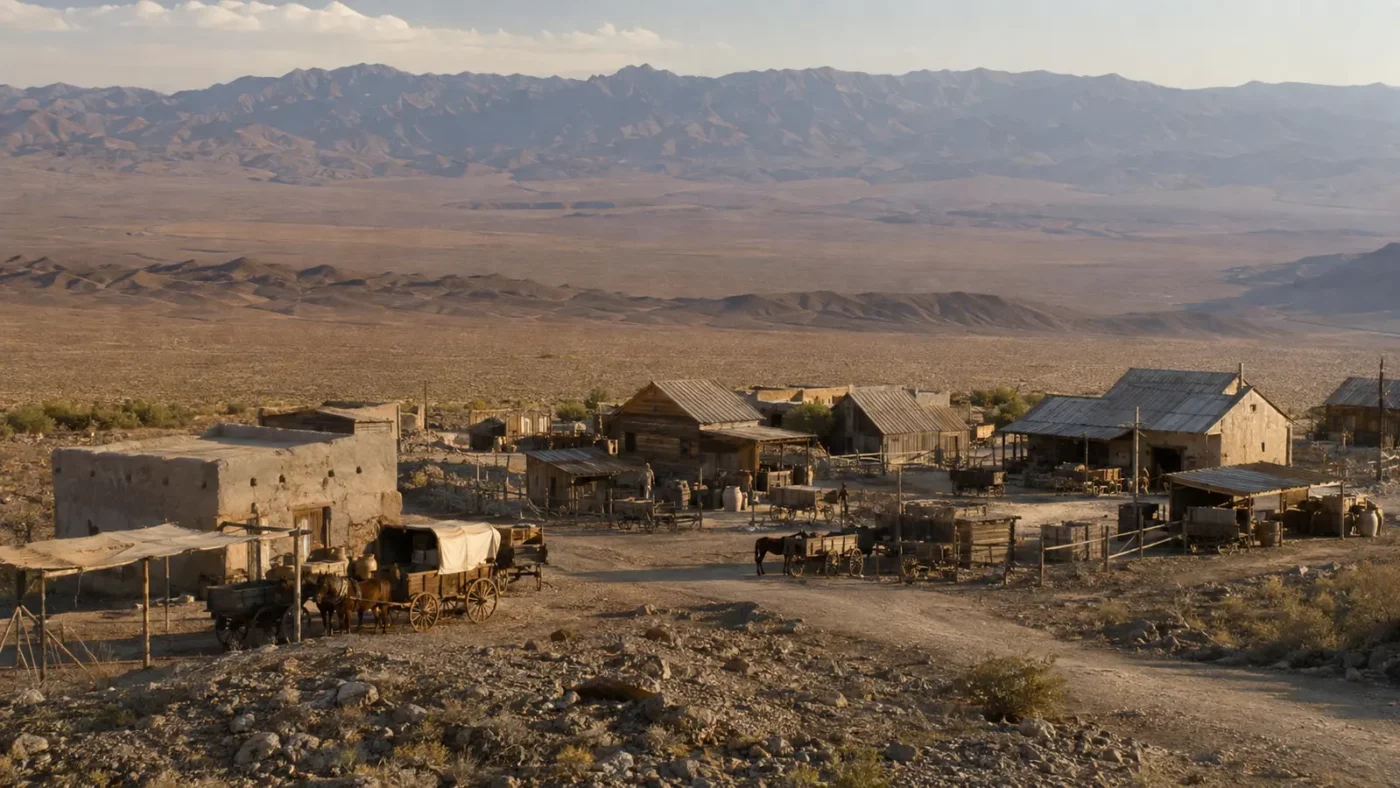
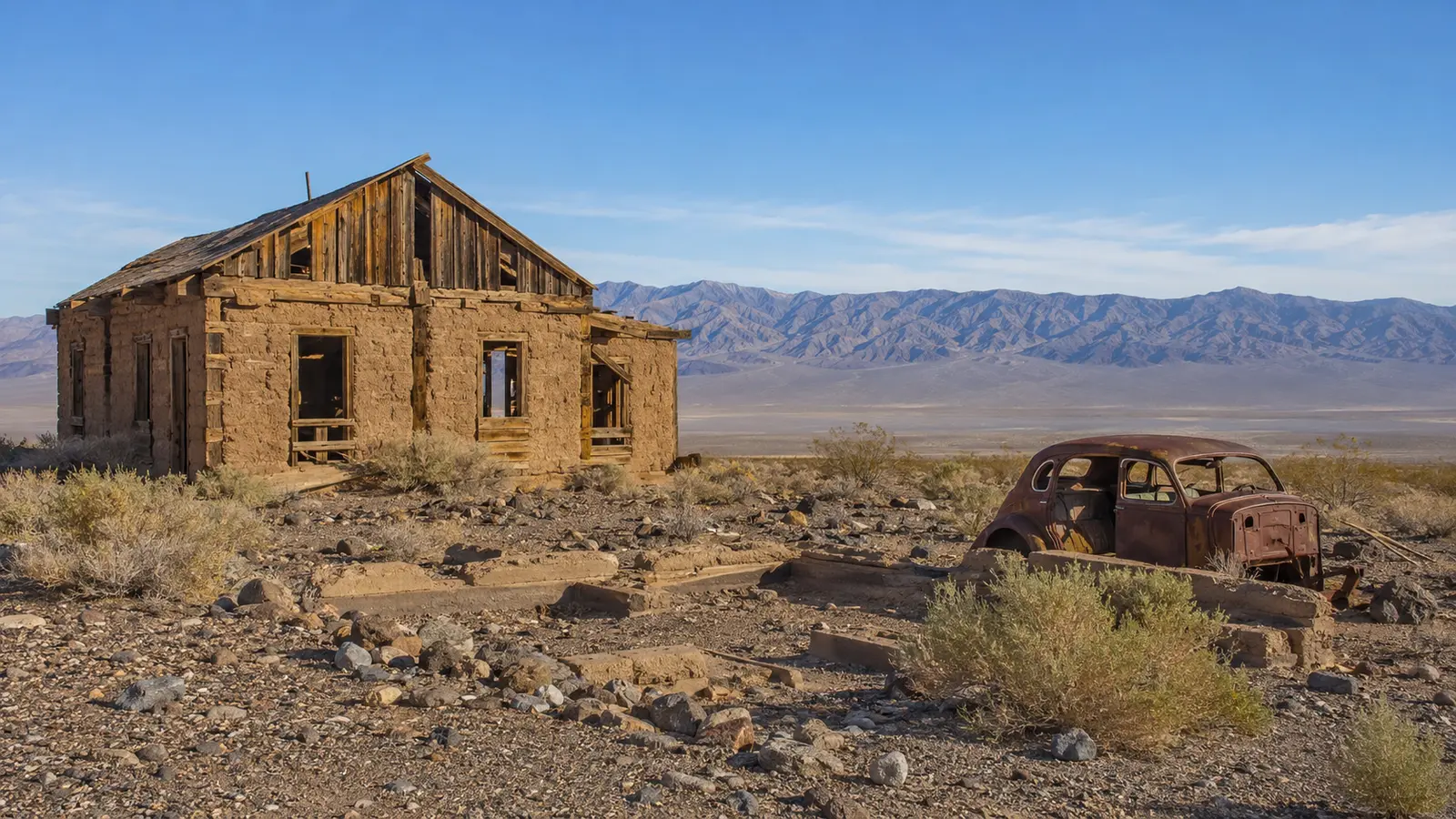
Ballarat’s adobe remains look solitary beneath the Panamint Mountains, but the town once depended on constant movement. Miners, freight, money and news crossed this valley on their way between scattered gold camps and the outside world.
Its story is less about one spectacular mine than a network of services that made remote mining possible. When that network contracted, the streets did not need a catastrophe to grow quiet.
A desert town built to serve other people’s strikes
Ballarat occupies a hard, open stretch of Panamint Valley, west of Death Valley proper, where the mountains appear close until a traveler tries to cross the distance between them. Its weathered adobe walls can make the settlement look like an isolated mining camp. In reality, Ballarat’s value came from connection. The town served prospectors and workers scattered through the Panamint Mountains, giving them a place to collect mail, buy supplies, find lodging and spend time away from remote claims. It was a hub for a larger mining landscape rather than the product of one spectacular vein beneath town.
That distinction explains both Ballarat’s growth and its vulnerability. A service town can prosper while several nearby mines are active, because its customers arrive from many directions. But it can also lose its purpose when those mines close in sequence. The town’s surviving buildings therefore tell a regional story: ore moved out of the mountains, while food, tools, news and people moved through the valley. Ballarat was where those movements briefly met, an improvised center in country where water, shade and reliable transportation were never minor details.
The busy years from 1897 to 1905
Gold discoveries in the Panamint Mountains brought Ballarat into being during the late 1890s. The National Park Service dates its heyday to roughly 1897 through 1905 and records a surprisingly complete town for such a remote place: seven saloons, three hotels, a Wells Fargo station, post office, school, jail and morgue. There were no churches. Those details reveal more than colorful frontier atmosphere. Hotels housed travelers, the express station connected money and parcels to the outside world, and the school signaled that families expected the settlement to last longer than a prospecting season.
The population reached about 400 in 1898, according to the park’s history. Ballarat’s businesses depended heavily on production at mines such as the nearby Radcliffe, which the National Park Service says yielded 15,000 tons of gold ore between 1898 and 1903. Miners came into town for practical errands and recreation, while teamsters and merchants negotiated the difficult movement of freight. Life was social, but never detached from extraction. Every stocked shelf, delivered letter and occupied hotel room ultimately relied on ore being valuable enough to justify the cost of working in the mountains.
A community shaped by roads, water and distance
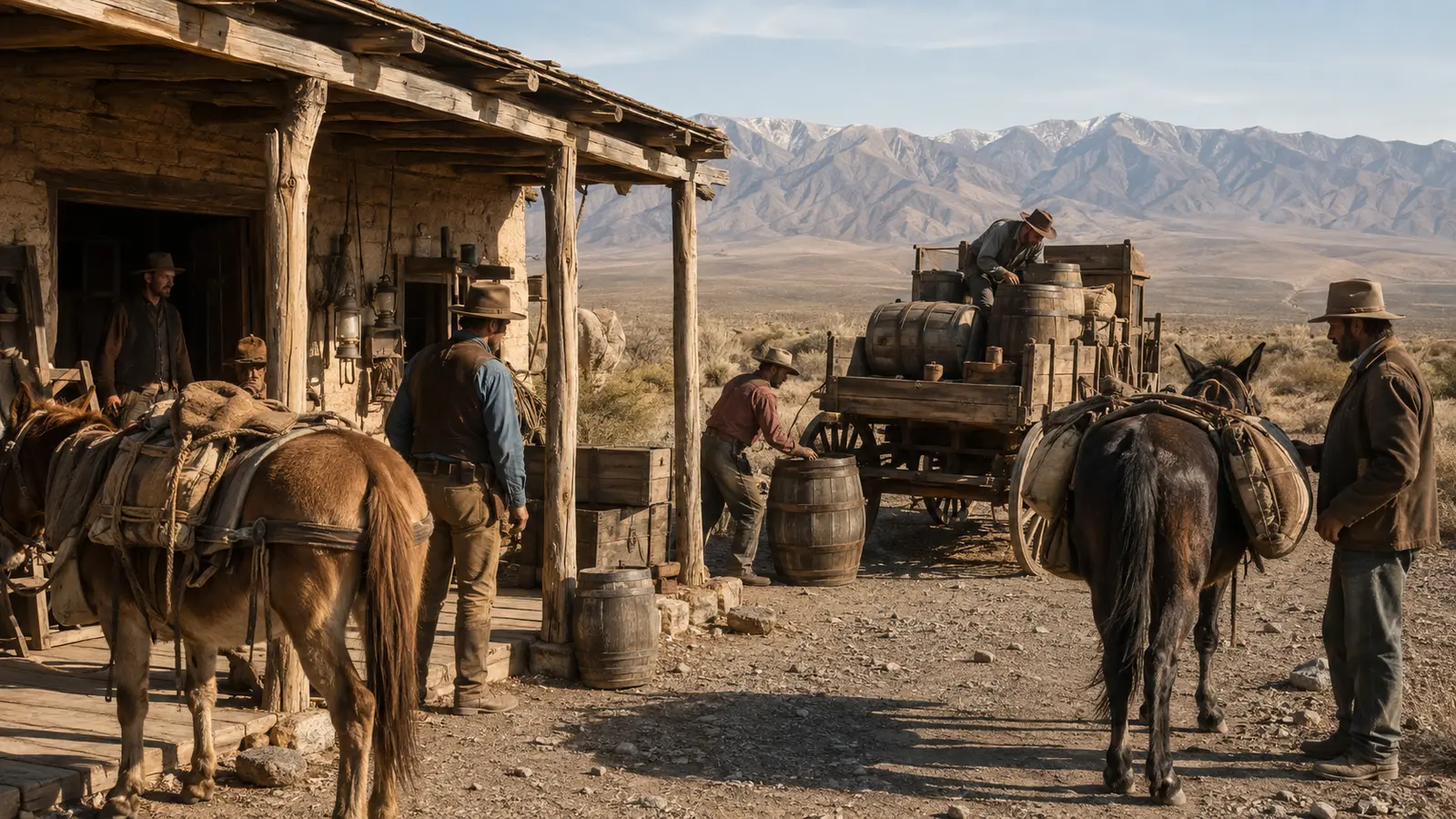
Ballarat was a place where geography entered every household decision. Supplies had to cross long desert approaches, summer heat could become lethal, and a broken wagon or exhausted animal could interrupt both business and survival. At the same time, the town offered the human contact missing from isolated claims. A miner might spend days working in a canyon and then travel to Ballarat for a meal, a drink, mail and conversation. That rhythm made the settlement a social anchor even for people who did not permanently live within its streets.
The town also appeared in a much wider transportation story. During the 1908 New York-to-Paris automobile race, the American Thomas Flyer reached Ballarat on March 22. The event did not rescue the declining settlement, but it captured a moment when the old supply stop intersected with a new machine age. Stage and wagon routes were giving way to automobiles, yet the desert still controlled speed. Ballarat’s location could connect mining camps to distant markets, but it could not make an exhausted ore body productive or guarantee a steady flow of customers.
How the network unraveled
Ballarat’s decline was gradual, not a single-night evacuation. As profitable mining weakened, fewer workers needed lodging, fewer teams hauled supplies and fewer customers supported the town’s businesses. The Radcliffe Mine ceased major operations, and the commercial web around it contracted. The post office finally closed in 1917, a useful marker of how far the settlement had fallen from its late-1890s peak. Buildings were abandoned, reused or lost to the desert, while a small amount of activity persisted around the site.
That uneven ending matters because the familiar phrase “ghost town” suggests a clean break between life and emptiness. Ballarat never fit that picture perfectly. Individual residents and caretakers remained associated with the place, and modern visitors may still encounter limited private activity. The ruins do not represent a community that simply failed to try hard enough. They show the consequences of dependence on a regional extractive economy: once enough surrounding mines stopped paying, a well-positioned service center no longer had the customer base required to sustain ordinary civic life.
Reading Ballarat responsibly today
Ballarat is frequently discussed alongside Death Valley ghost towns, but the historic townsite is privately owned. That fact should guide every visit. An old wall, vehicle or cabin is not public property merely because it looks abandoned. Visitors should follow posted instructions, stay within clearly permitted areas and never enter, climb or remove anything from a structure. Current ownership arrangements, road conditions and access expectations can change, so travelers should check official Death Valley National Park alerts and local information before leaving paved routes.
Desert preparation is equally important. Carry more water than expected, begin with adequate fuel, avoid relying on mobile service and treat extreme heat or flash-flood forecasts as reasons to postpone. Viewed with care, Ballarat offers a compelling lesson: some towns are built not on a deposit but on a network. Its adobe remains make sense when readers imagine the miners in surrounding canyons, the freight moving across the valley and the services that made remote work temporarily possible. When that network went quiet, the supply town quieted with it.
Primary reference: National Park Service — Perils of Opportunity: Mines and the Miners. This article uses original wording and editorial analysis rather than reproducing the source text.